

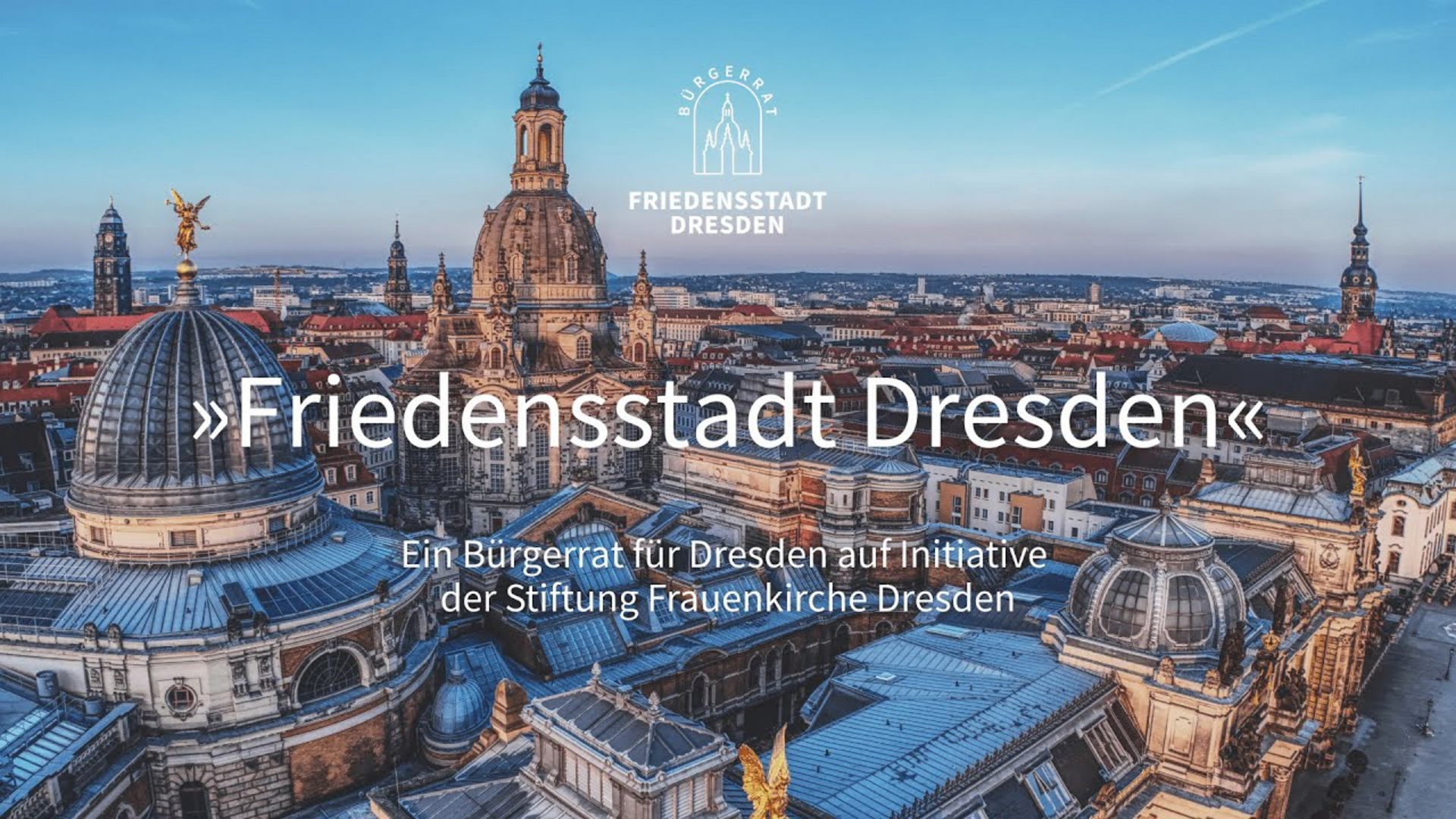
How do we want to live together in Dresden? This question was the focus of the “Peace City Dresden” Citizens’ Assembly. Over five days of meetings, 50 Dresden residents selected at random came together to jointly develop recommendations for peaceful coexistence. At a ceremonial event in the Frauenkirche on 8 May 2025, the citizens’ proposals were presented to Lord Mayor Dirk Hilbert and members of the City Council.
Shared values
The Citizens’ Assembly agreed on the following values:
- Peace means not only the absence of war and the mere fulfilment of basic needs, but so much more.
- For us, peace means being able to lead a just, safe and dignified life.
- It means respectful and appreciative communication within the community. To achieve this, we need the courage to embrace diversity and compromise.
- We treat one another with empathy, so that we can interact considerately, appreciatively and non-violently.
In its 107 recommendations, the mini-public calls, among other things, for people to show their faces at peaceful demonstrations. “We must not leave demonstrating to undemocratic and violent individuals, but want to actively shape demonstrations in a positive way,” states the citizens’ report by the participants.
Code of conduct for demonstrations
Civil society organisations committed to fostering good political coexistence should therefore develop a code of conduct for demonstrations and disseminate this “demonstration etiquette”. The democratic supporting programme at demonstrations should be designed to positively influence the atmosphere of the event. A “festival of democracy” could generate “positive feelings and images”.
During ongoing demonstrations, digital co-demonstrators could be made visible in the cityscape, for example through projections onto buildings. The Citizens’ Assembly also considers purely digital demonstrations a possibility.
All residents of Dresden must be able to take part in demonstrations without fear of attack and without reservations. To this end, a strong presence of security forces and rapid police intervention in the event of assaults or threats of violence must be ensured.
Rejection of violence
Violence against politically active individuals must not be left unchallenged. The mini-public therefore encourages the filing of complaints, letters to the editor, demonstrations or social media posts against such acts.
In the opinion of the Citizens’ Assembly members, Dresden needs more spaces for different groups to meet. To this end, the assembly participants recommend “coming into contact with other cultures, for example through sport or music, or even on playgrounds”. This appeal is directed “to the state capital Dresden, to the diverse organisations in the city, to schools, nurseries, religious communities and all individuals”.
At dinners organised by the city or by associations, “interested families and individuals, with and without a migrant background, should get to know one another in small groups on a random basis and invite one another to dinner”. Various measures are intended to strengthen gender equality and enable people with disabilities to participate more fully.
Awareness-raising campaigns
The Citizens’ Assembly members would like to see greater public awareness of the needs of lonely, elderly or vulnerable people, for example through municipal campaigns. The same applies to fostering civic courage.
To strengthen social cohesion, the Citizens’ Assembly recommends promoting “bridge-builders” between people. Those mentioned include officials and contact persons for neighbourhood work, such as social workers, neighbourhood managers and representatives in housing cooperatives. Digital opportunities for networking within the neighbourhood should also be utilised.
In Dresden, the City of Peace, preventive measures are needed to curb violence, threats and crime in public spaces. For the Citizens’ Assembly, this includes better street lighting and improved CCTV surveillance at selected locations and on public transport. Also mentioned are the deployment of mediators from the Saxon Security Watch, as a long-term urban planning measure, greater social diversity within the city, and the revitalisation of public spaces.
Greater safety in public spaces
Safety in public spaces is to be improved through measures such as public emergency call systems, personal alarms and safe havens. In the Citizens’ Assembly’s view, fears should be addressed through measures such as resilience training. It is proposed that existing conflict counselling centres be better signposted and promoted, and that a comprehensive awareness campaign on the subject of sexual harassment be launched.
For major construction projects, the assembly calls for early public participation, for example in the reconstruction of the Carolabrücke, which collapsed in September 2024. Various measures are intended to improve road safety in Dresden. “Clear and widely publicised regulations and higher fines can serve as educational measures to ensure that behaviour hindering traffic is reduced,” states the Citizens’ Report.
The mini-public also laments the displacement of lower-income individuals and families from the city due to rising rents. Affordable housing, alternative housing models and a community-oriented, natural living environment could promote peaceful coexistence among diverse people and foster connections between families. Noise conflicts should be resolved through noise abatement measures and dialogue forums, amongst other things.
Digital human chain
With regard to commemorating the victims of the Second World War, the Citizens’ Assembly believes that a digital platform can promote fact-based discussion and enable more people to participate in the commemoration of 13 February throughout the year. On 13 February 2045, up to 25,000 people died in the air raids on Dresden.
The initiative is intended to complement the existing human chain. The city should therefore set up a new website for the digital human chain, embedding the historical facts and sources relating to 13 February and the casualty figures. A discussion forum should be established on the website to facilitate constructive dialogue on the subject.
Establishing Dresden as a City of Peace
Last but not least, events and institutions should be used to establish Dresden as a City of Peace at local, national and international levels. “For us, this involves building and expanding partnerships and networks, as well as raising the profile of Dresden as a City of Peace,” write the citizen assessors.
The list of proposals from the Citizens’ Assembly members concludes with the statement: “We have had the honour of participating in the ‘City of Peace’ Citizens’ Assembly. The experience was so constructive that we would like to see further Citizens’ Assemblies.”
3,000 people invited
For the “City of Peace Dresden” Citizens’ Assembly, 3,000 randomly selected residents of the city were contacted and invited to take part. From the 183 responses, a group of 50 people was formed that reflected the diversity of the city’s society – comprising people of different age groups, educational backgrounds and life stories, as well as from various neighbourhoods. This ensured that a wide range of perspectives and experiences were incorporated.
The Citizens’ Assembly met for the first time on 7–8 March. Further sessions followed on 19, 28 and 29 March.
Discussion in the City Council
On 28 August 2025, the Dresden City Council discussed the recommendations of the “City of Peace Dresden” Citizens’ Assembly. During the debate, the Greens praised the Citizens’ Assembly as a tool for public participation that should continue to exist in the future. The City Council should take the proposals seriously.
Some proposals were well-intentioned but questionable, according to the FDP/FB parliamentary group. For example, the expansion of CCTV surveillance. The body was neither representative nor democratically legitimate. However, they would take some ideas on board. The AfD also criticised the composition of the group, referring to “left-liberal and green-tinged issues”. Furthermore, individual security measures did not tackle the root cause.
Recommendations took the tram
The Dresden Frauenkirche Foundation organised events on the topics and recommendations of the mini-public and invited participants, experts, decision-makers and interested parties to further develop the ideas and their concrete implementation. Through the metro_polis democracy project, recommendations from the Citizens’ Assembly on the issues of “rudeness and lack of consideration” and “violence and intimidation in public spaces” were shared with the public on Dresden’s trams, and feedback was collected.
The experience gained from this Citizens’ Assembly is to be used to develop and establish further participatory formats in the long term and, ideally, to launch another Citizens’ Assembly.