

Dare to have less democracy?
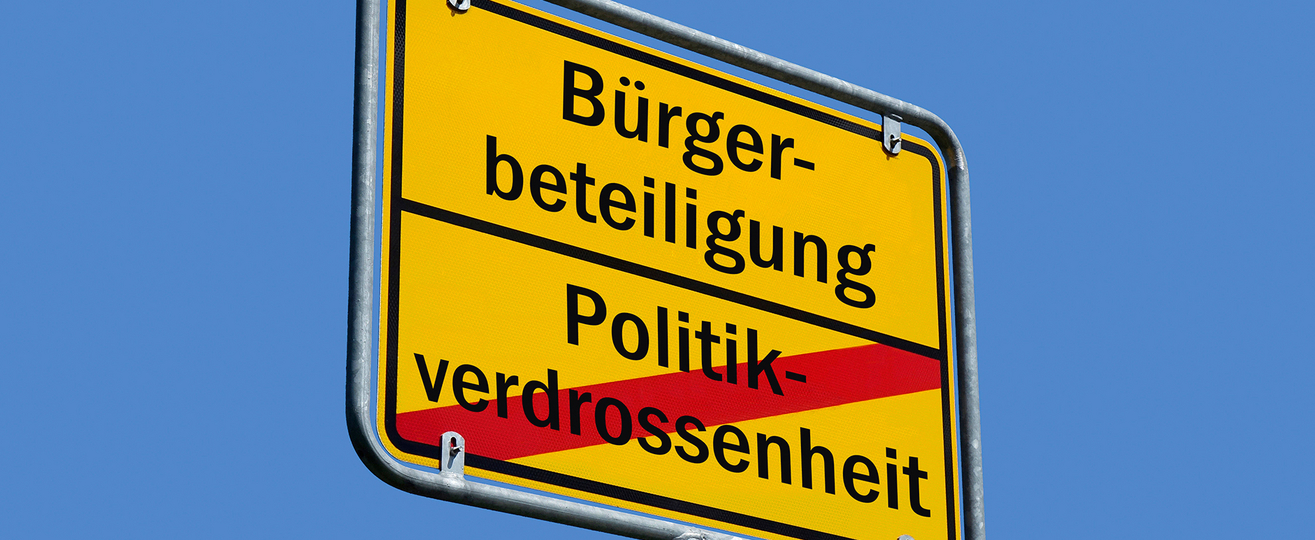
Many citizens are concerned about the state of German democracy. A large number of initiatives and organizations are attempting to address the widespread unease with stagnant political parties and to embed democracy in the population. In doing so, they often become disheartened by the stubborn rejection of such proposals and the obstruction by the ruling parties. This raises the question: How can the ruling parties’ resistance to expanding citizens’ opportunities for participation and co-determination be overcome?
In this context, it is worth recalling the Böckenförde Paradox, formulated by constitutional law scholar Ernst-Wolfgang Böckenförde: “The liberal, secular state depends on conditions that it cannot itself guarantee.” A functioning democracy requires responsible citizens who act in solidarity and assume political responsibility; the state cannot decree or enforce these moral values and attitudes.
The reality of party democracy in Germany now presents a disturbing picture: Over the past 50 years, the SPD has lost two-thirds of its members; between 1990 and 2023, the parties represented in the Bundestag recorded a 54 percent decline in membership.
These developments point to a CDU paradox: In the face of the AfD’s growing electoral success and the threat to democracy, the CDU, while in government, does not respond with “revitalizing” measures such as federal citizens’ assemblies (including a requirement for the Bundestag to address the assemblies’ recommendations) or federal binding referendums, but instead acts as if there were a general suspicion toward the nonprofit sector or toward a civil society that is democratically engaged and active. In February 2025, for example, the then-opposition CDU/CSU parliamentary group posed 551 questions to the red-green federal government regarding state funding for civil society NGOs and associations.
We therefore do not want to leave the topic of democracy to the political parties: On June 16, 2026, at 7 p.m., the Humanistische Union invites you to a virtual panel discussion with audience participation. Panelists:
- Dr. Katharina Liesenberg, union secretary at ver.di and board member of Demokratie Innovation e.V.
- Dr. Emily Katzenstein, Gerda-Henkel Postdoctoral Fellow and lecturer in political theory and social theory at the Technical University of Munich.
- PD Dr. Veith Selk, Administrative Director of the University Chair in Political Science at the University of Vechta.
- Prof. Dr. Roland Roth, Professor of Political Science in the Department of Social and Health Services at Magdeburg-Stendal University of Applied Sciences until 2014, co-founder of the Institute for Protest and Movement Research (ipb).
- Dr. Philip Dingeldey, Federal Executive Director of the Humanist Union and Editor-in-Chief of *vorgänge*. Journal of Civil Rights and Social Policy.
Moderator: Laura Schiller
Participation in the event is free of charge. Please register by emailing info@humanistische-union.de