

Do multilingual citizens´ assemblies work?
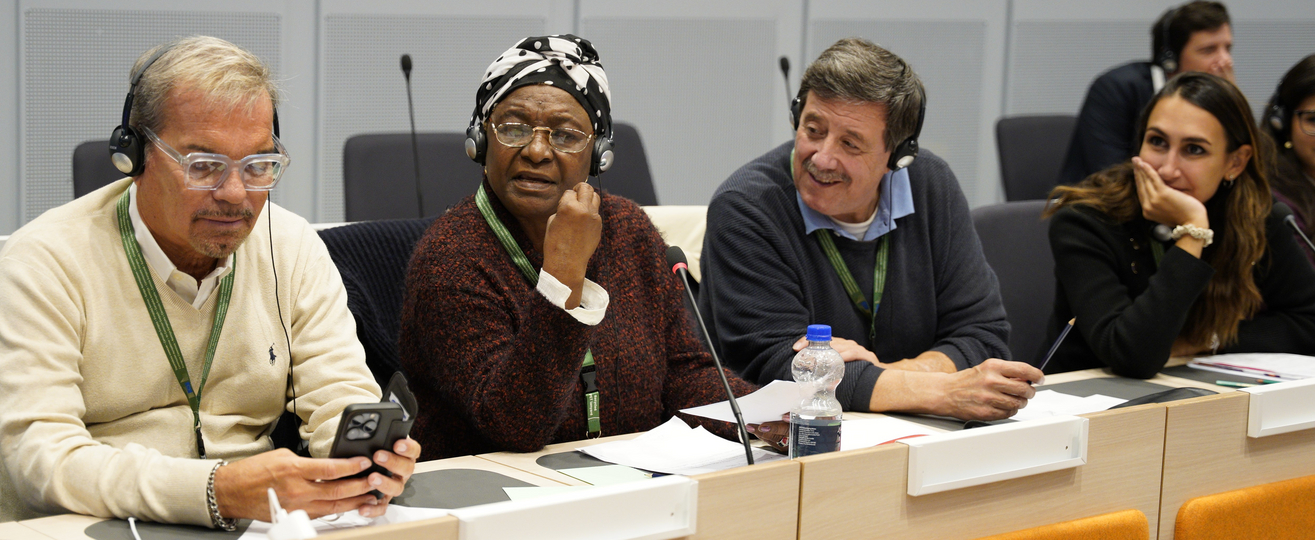
In many contexts, multilingualism is a major design consideration for citizens’ assemblies.
This applies whether an assembly operates across multiple official languages, or simply reflects the linguistic diversity of its members. Typically it means some mixture of live interpretation, language buddies, multilingual facilitation, and technology coming together.
But do multilingual citizens’ assemblies actually work, and how? What are the trade-offs and considerations of the different approaches available? How are facilitators seizing the challenge as an opportunity to design a smooth and inclusive process?
In this DemocracyNext webinar, the international research & action institute will launch two reflection briefs; one by Hugh Pope about the EU citizens’ panel, and one by James MacDonald-Nelson and Hannah Terry about the Esch-sur-Alzette (Luxembourg) citizens’ assembly.
The EU citizens´ panel covered the full breadth of EU linguistic diversity across 150 members and 24 languages. In Esch, the assembly works primarily in Luxembourgish, French, German, and English - and has also integrated Turkish, Arabic, and Portuguese.
Join this webinar for a conversation spanning facilitation, interpretation, and technology. The question running through it all: can linguistic diversity be an asset to deliberation, not just a challenge to manage?
What will be explored
- What multilingualism looked like in both an EU citizens’ panel and the Esch-sur-Alzette citizens’ assembly
- The human-centric roles of interpretation
- How technology can aid the process
- Takeaways about the challenges, trade-offs, and opportunities of multilingual deliberation
Speakers
- James MacDonald-Nelson, DemocracyNext
- Hugh Pope, Member of the International Advisory Board, DemocracyNext
- Constantin Schäfer, Head of EU Relations and Projects, ifok
- Jorim Theuns, Co-Founder, Dembrane
- Liz Thielen, Senior Facilitator, Snakke & Co
- Lisa Verhasselt, Research Associate, Luxembourg Institute for Socio-Economic Research (LISER)
Moderator: Claudia Chwalisz, Founder and Managing Director of DemocracyNext
This seminar will be recorded and made available after the event via DemocracyNext’s YouTube and Spotify channels.