

"We are giving them the keys"
Somewhere in Connecticut, a pensioner opens an envelope and reads that the state has chosen her for an unusual task. A few towns away, an engineer initially sets the same letter aside. A nurse wonders whether this is really serious. A student wonders whether he can spare the time for it.
They do not know one another. They belong to different generations, live in affluent suburbs or economically deprived towns, and vote for Democrats, Republicans or not at all. What connects them is chance.
Nobody here has ever campaigned
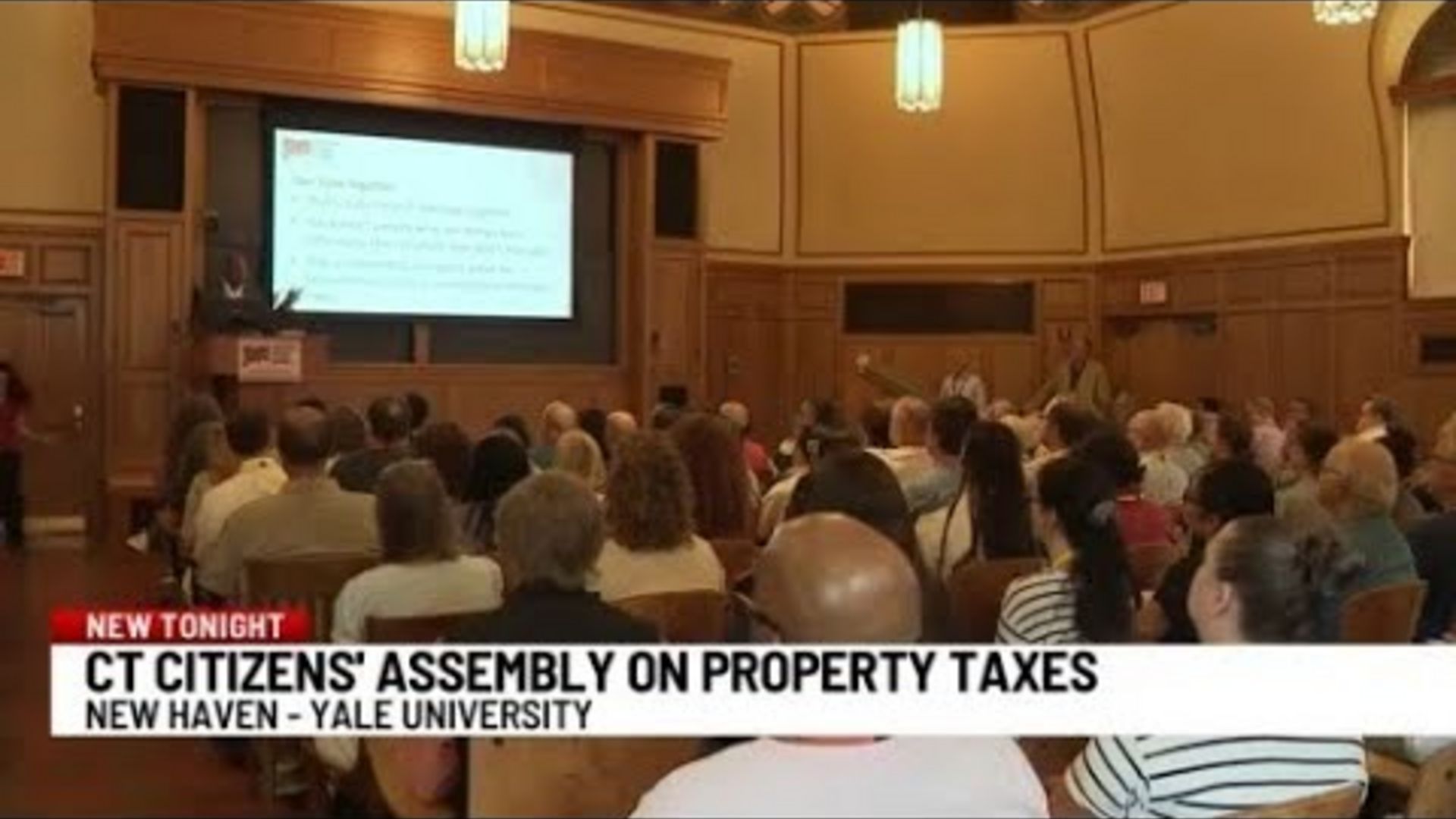
On 11 July 2026, they gather for the first time around round tables on the Yale University campus. Name tags sit in front of coffee mugs, moderators hand out documents, and the first discussions begin tentatively. No one here has campaigned in an election; no one has had to show a party membership card.
And yet these hundred people are set to attempt something that parliaments have failed to achieve for decades: to develop proposals for reforming Connecticut’s property tax system – a long-standing political dispute that has preoccupied generations of legislators.
The certainties of representative democracy called into question
The scene seems unspectacular. And that is precisely why it exerts a peculiar power. For it calls into question one of the oldest certainties of representative democracies: that political decisions must, above all, be prepared by elected politicians.
Behind this experiment is a woman who has been challenging this assumption for years. Hélène Landemore, a Franco-American political scientist at Yale University, is one of the most internationally renowned advocates of a democracy that relies more heavily on citizens selected by lottery. In her books, she describes political diversity not as an obstacle, but as a resource.
Better decisions
She is convinced that diverse experiences often lead to better decisions than expert panels made up of people who are very similar to one another – provided that people are given time, information and a fairly moderated space for collective reflection.
Connecticut is now her most high-profile real-world test in the United States to date.
Independent process design
“We are giving them the keys on day one,” says Landemore. At first, the sentence sounds like a metaphor. In fact, it describes the organisational principle underpinning the entire Citizens’ Assembly. The researchers develop the framework and organise the facilitation and proceedings. But as soon as the mini-public begins, the citizens are expected to make as many decisions as possible themselves.
Which issues they wish to explore in greater depth. Which experts should be invited back. Who speaks publicly on behalf of the group. Even the use of artificial intelligence to analyse statements is ultimately to be decided by the members.
“We supply scaffolding,” explains Landemore. „But once they arrive, we aim to maximize their autonomy.“
Shaping policy
It is a remarkable shift in perspective. Here, citizens are not regarded as the audience of politics, but as its co-creators.
The idea did not come out of nowhere. Citizens’ assemblies now exist in many democracies. In Ireland, a randomly selected assembly paved the way for public debate on same-sex marriage and, later, on abortion rights. France had randomly selected citizens deliberate on climate policy. East Belgium has permanently integrated citizens’ assemblies into its political system. Yet in the United States, such processes have so far remained rare and mostly confined to the local level.
An age-old problem
The fact that Connecticut, of all places, is now leading the way has to do with a political problem that is almost as old as the state itself.
Local authority funding there depends to a large extent on property tax. Wealthy municipalities therefore have significantly greater financial leeway than economically weaker ones. For decades, the system has been regarded as in need of reform. For just as long, attempts at reform have failed due to the conflicting interests of regions, municipalities and political parties.
Perhaps, so hope the initiators of the citizens’ assembly, it is precisely people who are not involved in politics on a daily basis who are needed.
A cross-section of society
The path to the Citizens’ Assembly begins with a random selection. Thousands of households receive invitations. Anyone wishing to take part volunteers to do so. Only then is the final group assembled – in such a way that it reflects Connecticut as accurately as possible: by age, gender, income, ethnic background, level of education, place of residence and political orientation. It is not the loudest voices that are to be represented, but a cross-section of society.
Participants receive an allowance to cover their expenses. Above all, however, they are given time – a scarce commodity in political debate.
They hear from experts in academia, public administration and local politics, as well as from representatives of various interest groups. They discuss issues in small groups, ask questions, challenge one another’s views and formulate recommendations. The aim is not speed, but sound judgement.
“Experts on tap, citizens on top”
Landemore sums up this role reversal in a phrase that has long since become a motto amongst democracy researchers: “Experts on tap, citizens on top.”Experts are on hand. It is the citizens who are to decide.
How far might their proposals go? Landemore smiles at the question. She deliberately does not wish to set any limits. "If they want to propose a complete, implausible redesign of the system, they can. We put no limit on the outcome."
It is a statement that sounds unusual in the world of politics. Normally, reforms begin by pointing out everything that is impossible. Here, the process begins with the opposite assumption.
Thinking through solutions with strangers
This openness also seems to be making an impression among the members. Brooke Evans explains that she applied even though she initially knew little about citizens’ assemblies. Naturally, she is concerned about property tax. Older people, in particular, are suffering from the rising financial burden. For her, however, something else was decisive: the opportunity to think through solutions together with strangers, rather than merely observing political debates from the sidelines.
Perhaps this is precisely what makes this experiment so unique.
Democracies invest enormous energy in the competition for power. Elections, campaigns, majorities, opposition – all these are part of their very nature. By contrast, far less attention is paid to the question of how citizens think together before they make decisions.
Joint deliberation rather than competition
The Citizens’ Assembly in Connecticut shifts the focus. The emphasis is not on political competition, but on joint deliberation. Listening becomes a method. Chance, at least temporarily, replaces competition. Strangers come together to form a working body.
The members aim to adopt their recommendations by the final meeting. These will then be presented to Parliament and the public and incorporated into the legislative process. Whilst they are not legally binding, they are likely to carry political weight – not least because Connecticut is facing an election year this autumn and candidates will find it hard to ignore the Citizens’ Assembly’s proposals.
Democracy is more than just voting
But even then, the experiment would already have raised a question that extends far beyond Connecticut: what if democracy could be more than just a regular trip to the ballot box?
Perhaps an answer really does begin with a letter.
Note: This article was written with the help of AI.