

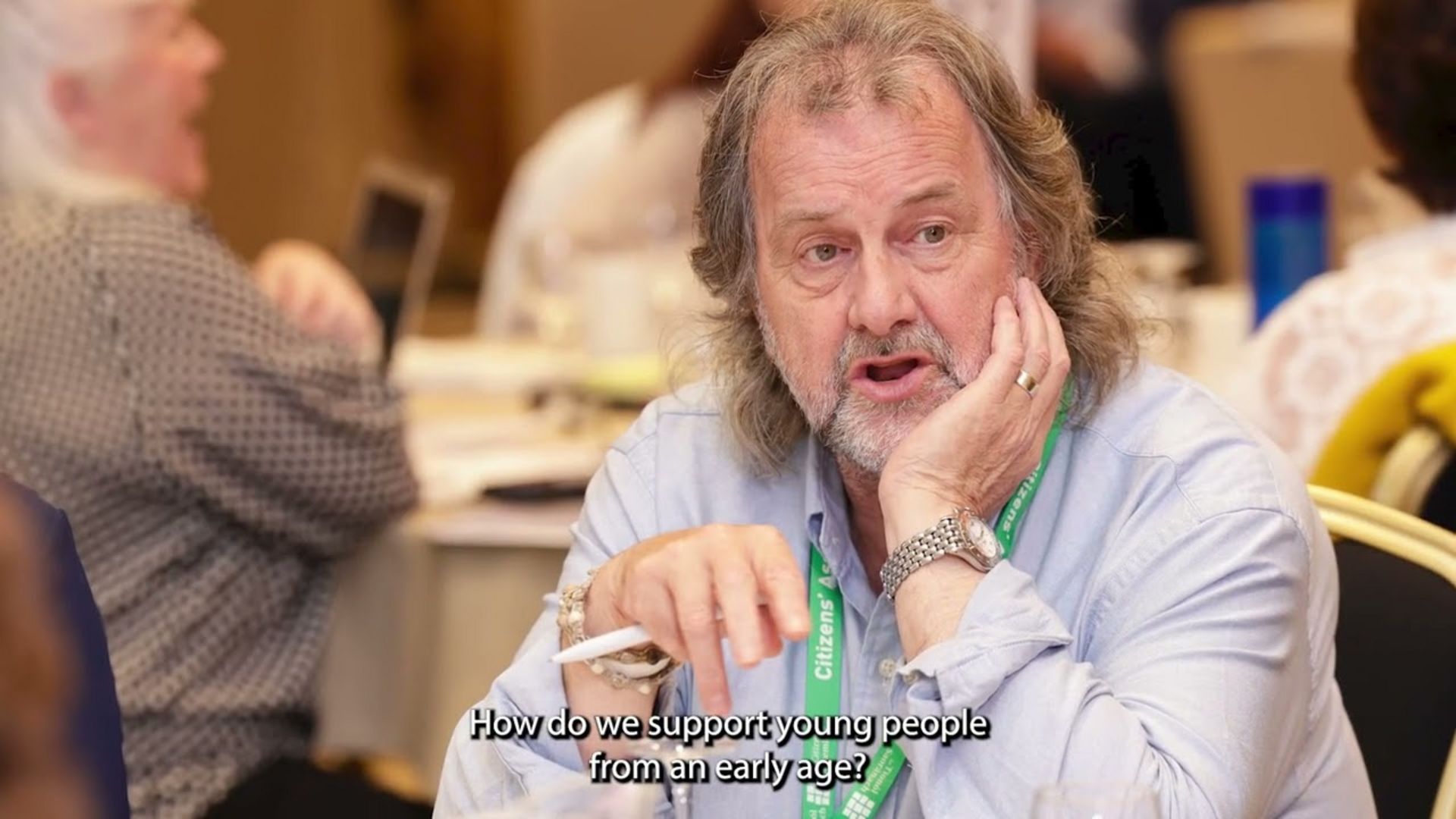
The influence of the Citizens’ Assembly on Drug Use is clearly visible in Ireland’s new drugs strategy. The Government has adopted its central idea of a health-led drugs policy, strengthened prevention, treatment and harm reduction, and created new rules for putting the strategy into practice. Yet it has stopped short of the assembly’s most important political demand: the broad decriminalisation of drug possession for personal use.
On 13 October 2026, the Irish Government approved the National Drugs Strategy 2026–2030 and a first action plan covering the years 2026 to 2028. The Department of Health explicitly states that the strategy includes the Government’s response to the Citizens’ Assembly’s 36 recommendations. However, not every point of agreement can be attributed to the assembly alone. Reports by a parliamentary committee, a public consultation, an assessment of the previous drugs strategy, and statements from experts and organisations also shaped the document.
A Citizens’ Assembly sets the direction
The Citizens’ Assembly met over six weekends between April and October 2023. It consisted of 99 randomly selected residents and its independent chair, Paul Reid. Invitations were sent to 20,000 households. From those who responded, a group was selected to reflect the population as closely as possible in terms of age, gender, social background and place of residence. In January 2024, the assembly published its final report containing 36 recommendations.
At the heart of its work was a fundamental change of direction: drug use and addiction should be treated primarily as health and social issues. The assembly called for better prevention, more accessible support, increased funding for treatment and recovery, a stronger role for people with direct experience, and alternatives to criminal penalties.
Reid described the meetings as the “most comprehensive, wide-ranging and representative discussion on all aspects of drug use and drugs policy” ever held in Ireland. The members discussed not only criminal law, but also poverty, homelessness, mental illness, pressures on families, organised crime and unequal access to support services.
The Citizens’ Assembly’s influence
This understanding now also shapes the new drugs strategy. Its five main areas cover prevention, equal access to treatment, recovery and participation in society, health support for people in contact with the criminal justice system, and responses to new drugs and changing drug markets. The Government describes health, wellbeing and human dignity as central to its approach.
Several recommendations made by the Citizens’ Assembly appear as concrete tasks in the action plan. These include:
- a national prevention strategy;
- an expansion of treatment and support services throughout the country;
- a stronger role for people with direct experience and their families;
- services tailored to women, minority groups, people with disabilities and people whose brains process information and sensory input differently;
- better treatment and recovery services in prisons and support after release;
- improvements to drug treatment courts and other alternatives to imprisonment;
- expanded drug testing and early-warning systems;
- consideration of further medically supervised drug consumption facilities;
- measures to counter the disparagement of people who use drugs and to address drug-related intimidation and violence.
Important demands made by the Citizens’ Assembly have therefore been translated into tasks for government departments, health authorities, the police, the prison service and social service providers. For each measure, the action plan names the responsible bodies, the people the measure is intended to reach and ways of assessing its success.
Greater oversight of delivery
The Government has also partly followed the Citizens’ Assembly’s recommendations on political leadership. The assembly called for responsibility at the highest level of government, cooperation between all relevant departments and regular public reports. It also recommended a dedicated Cabinet committee on drugs chaired by the Taoiseach, Ireland’s prime minister.
The Government has not created such a dedicated committee. Instead, the existing Cabinet Committee on Health, which is chaired by the Taoiseach, will oversee the delivery of the drugs strategy. A committee bringing together the relevant government departments, chaired by the Minister of State responsible for the National Drugs Strategy, will support this work.
A new national committee for delivery and oversight is expected to meet every three months and publish annual reports on progress, difficulties and the work of individual government departments. Its members are to include representatives of public bodies, Drug and Alcohol Task Forces, social organisations and academic institutions, as well as people with direct experience and their families.
The Citizens’ Assembly’s proposal has therefore not been adopted word for word, but its aim of stronger political responsibility and public scrutiny is clearly reflected in the new arrangements. The same applies to the call for annual action plans. The Government has initially presented a plan containing 33 measures for 2026 to 2028, with another plan announced for 2029 and 2030. It has accepted the idea of measurable action, but not the annual timetable proposed by the assembly.
The crucial gap
The Government departs most clearly from the Citizens’ Assembly’s proposal on the possession of illegal drugs for personal use. The assembly recommended a comprehensive health-led response. Possession would remain unlawful, but people should, as far as possible, no longer face a criminal conviction or imprisonment. The proposal combined voluntary referral to health services, measures intended to discourage drug use and decriminalisation.
The Government has instead introduced a limited referral scheme. Since September 2026, people found in possession of drugs for personal use for the first time can be referred to the health service. Taking part in the consultation is voluntary, and there is no penalty for failing to attend.
On a second occasion, the police may issue an adult caution, but this currently applies only to cannabis. Extending it to other drugs is to be considered. Criminal proceedings remain possible after that.
The health-based option proposed by the Citizens’ Assembly has therefore been expanded, but this does not amount to comprehensive decriminalisation. Possession remains a criminal offence, and prosecution is merely avoided in certain cases. The Government has implemented this central recommendation only in part. The parliamentary committee went further and called for decriminalisation to be set out in law.
More money, but no lasting promise
The 2027 budget provides €7 million to begin carrying out the strategy. A further €1.5 million will expand existing schemes. The funding includes €3.45 million for health services in different parts of the country, €2.4 million for Drug and Alcohol Task Forces and €700,000 for prevention work with children and young people.
This responds to the Citizens’ Assembly’s call for additional funding, but it does not yet meet its demand for substantial, long-term and clearly traceable funding for all drug services. The strategy itself acknowledges that further resources will be needed for full delivery. Whether these will be provided in future budgets remains open.
Influence without full adoption
The Citizens’ Assembly did not write Ireland’s drugs strategy on its own. Nevertheless, it visibly changed the political framework. The Government has adopted its health-led direction, given greater weight to prevention and treatment, strengthened the role of people with direct experience, expanded alternatives to imprisonment and introduced clearer rules for delivery and oversight.
Yet the 36 recommendations have not been implemented in full. Some have been turned directly into measures, while others have been changed or reduced to commitments to examine possible action. On decriminalisation – the most visible and politically contested issue – the Government has chosen a much more cautious approach.
The Citizens’ Assembly’s influence can therefore be seen less in the unchanged adoption of its full programme than in a shift of direction. Irish drugs policy is now intended to focus more strongly on health, support and harm reduction. Whether this leads to lasting change in practice will depend on funding, public oversight and further political decisions.
As Minister of State Jennifer Murnane O’Connor said when presenting the strategy, publishing a strategy is “only the beginning”. What matters is putting it into practice.