

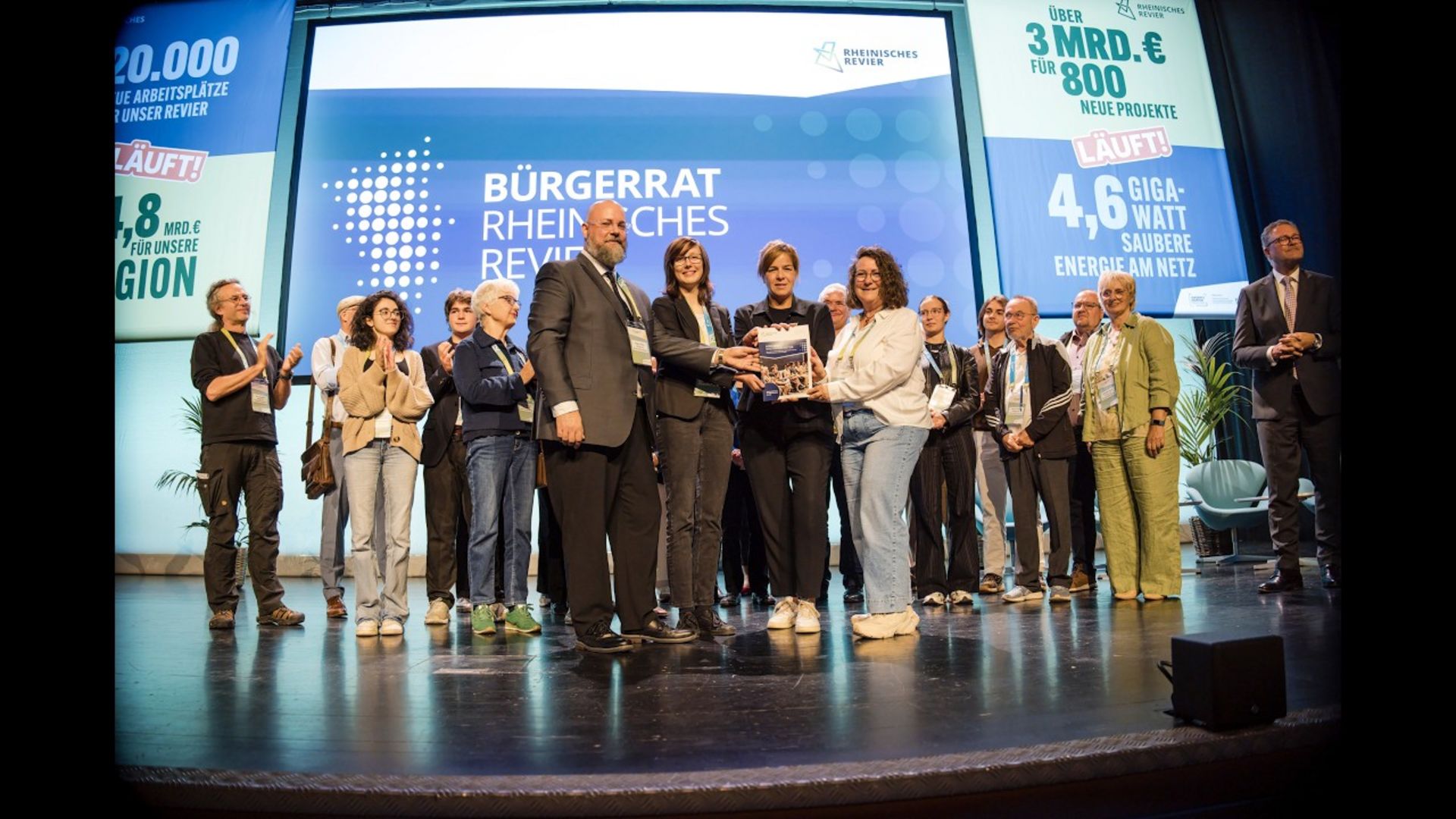
97 randomly selected citizens show what the Rhenish mining region needs beyond billions in funding and major projects. The government of the German state of North Rhine-Westphalia must now respond to their recommendations.
Structural change in the Rhenish mining region is usually described in terms of billions of euros, funding programmes and major projects. The Rhenish Mining Region Citizens’ Assembly takes a different approach: What needs to change so that people will continue to regard their region as a good place to live, with reliable services and transport links?
Ten recommendations
Its answer consists of ten recommendations, covering everything from meeting places and schools to buses, trains and healthcare. On 24 September 2026, the Citizens’ Assembly presented its approximately 60-page “Final report with recommendations” to North Rhine-Westphalia’s Minister for Economic Affairs Mona Neubaur at the “Perspectives 2026” regional conference in Bergheim.
North Rhine-Westphalia’s Minister for Federal and European Affairs, International Affairs and Media, Nathanael Liminski, paid tribute to their participation: “The people of the Rhenish mining region are taking responsibility for the future of their home.”
A microcosm of the region debates the future
The state government had approved the creation of the Citizens’ Assembly on 16 September 2025. Around 7,000 randomly selected residents subsequently received an invitation. From those who responded, 100 people were selected to reflect the region’s diversity as closely as possible in terms of age, gender, education and geographical distribution.
The ministry did not determine the precise question on its own. A preparatory group consisting of eight citizens and eight state government representatives formulated the guiding question:
How can the Rhenish mining region become an attractive region in which people want to live and can enjoy a good quality of life?
The members met in Jülich for six days over three weekends in May, June and July 2026. Around 70 to 80 citizens participated in each weekend session. Experts provided information and a variety of perspectives, while the participation consultancy Zebralog structured and facilitated the deliberations.
Motivated people
Rebecca Peters of Zebralog described her impression of the group: “What impressed me most was how motivated the people who came here were.” The methodological challenge was to bring together 97 different perspectives while ensuring that as many people as possible had an opportunity to speak. The work therefore alternated between plenary sessions, conversations in pairs and small groups whose composition was repeatedly changed.
The participants themselves also had specific expectations of the Citizens’ Assembly. In a video produced by the regional development agency, one young male participant said that he wanted to “bring a young person’s voice into the discussion”. A young female participant hoped “that our recommendations will be noticed and that we really do have a voice”.
Detailed ideas worked out
Johanna Schloemer from Hückelhoven was also there. She explained her concerns to WDR: “I was personally involved in the section on energy and climate protection. And that’s something that’s particularly close to my heart,” says Schloemer. We saw just how many hot days there were this summer. “And of the six days we spent in Jülich, five of them saw temperatures above 30 degrees without air conditioning.” So: “If we don’t think about environmental protection and the climate in situations like that, well, then I really don’t know what to say.”
The Hückelhoven resident believes that the recommendations will be taken seriously by politicians. Particularly because the Citizens’ Assembly has drawn up very detailed proposals. “If they were implemented exactly as they stand, that would of course be brilliant. I think the reality is somewhat different. It’s more likely that the measures will be scaled back a little. But in broad terms, that’s the direction things will take. I’m firmly convinced of that.”
Decisions with visible dissent
The Citizens’ Assembly did not rely solely on simple majorities. During the final evaluation, members could use coloured cards to express agreement, reservations or strong opposition. All ten recommendations were adopted. The report nevertheless records how many yellow cards were shown for each proposal, ranging from one to 14. This makes it possible to see where reservations remained within the Citizens’ Assembly.
The Citizens’ Assembly also placed a preamble before the recommendations themselves. It sets out requirements that should apply to all ten proposals: sustainability, accessibility, transparent information, citizen-friendly public administration and meaningful public participation during implementation. Public participation, it argues, should not end when the report is presented.
Meeting places and an identity fund
The first three recommendations focus on social cohesion. Municipalities should work with residents to identify buildings, squares and other spaces that could serve as local meeting places. The examples cited include libraries, youth centres, club premises, vacant buildings, open spaces and sports facilities.
These places should be accessible, easy to reach and suitable for different age groups. The Citizens’ Assembly also proposes secure funding for running costs and local coordinators. They would connect services, support citizens engaged in voluntary work and ensure that the initiative creates not merely rooms but genuine communities.
The third recommendation goes further: a regional identity fund should support projects that strengthen cohesion and a shared identity across the Rhenish mining region. Citizens should participate in decisions about the allocation of funds. The report identifies both a participatory budget and a citizens’ fund as possible models.
Education as part of structural change
Three further recommendations concern schools and education. The Citizens’ Assembly calls for all-day childcare until at least 4 p.m., healthy meals, smaller classes and teams comprising teachers, social workers, psychologists and other specialists.
Schools should also be able to respond more flexibly to the different circumstances of children and young people. According to the Citizens’ Assembly, this should include individual timetables, a wider range of options and closer cooperation between different types of schools.
One particularly specific demand is for a free education or school travel pass. It should be valid throughout the areas covered by the Rhine-Sieg Transport Association and the Aachen Transport Association and should not depend on a minimum distance between a pupil’s home and school. Mobility is thus explicitly understood as a prerequisite for equal educational opportunities.
Getting around more easily without a car
In the field of public transport, the Citizens’ Assembly also looks beyond existing district and transport association boundaries. It proposes a joint mobility plan for the entire Rhenish mining region. Existing plans should be reviewed, gaps identified and investments prioritised according to transparent criteria.
To strengthen public transport, the report calls for more frequent services, better connections between buses and trains, real-time digital information and mobility hubs linking different means of transport. Community buses, on-demand buses and shared taxis should complement these services.
The members also call for fares to be simplified gradually. The long-term objective is a single fare system covering the entire Rhenish mining region. In doing so, the Citizens’ Assembly addresses an everyday problem that is particularly evident in a region divided by numerous municipal and transport boundaries.
Medical centres and support in old age
The ninth recommendation calls for regional medical centres. General practitioners, specialists, therapists, pharmacists and other healthcare professionals should work together in the same location wherever possible. Telemedicine and mobile services should supplement this provision.
The tenth recommendation concerns older people and those in need of care. A central, free and proactive advisory service should help them find and coordinate support. The Citizens’ Assembly also proposes a digital platform and a telephone information service.
Advice should not begin only when a person is already in urgent need of care. It should also cover housing, mobility, loneliness, neighbourhood assistance and advance planning. In this way, the Citizens’ Assembly links medical and social care.
Presentation does not mean implementation
None of the ten recommendations became a political decision simply because the report was presented. The Ministry for Economic Affairs announced that it would assess the proposals and then discuss with the Citizens’ Assembly which ideas could be implemented and pursued further.
At the presentation, Minister for Economic Affairs Mona Neubaur said: “We take these recommendations seriously.” The state government intends to continue its dialogue with the Citizens’ Assembly. At the beginning of the process, she had already stated its ambition: “We are not making decisions over people’s heads, but together with them.”
Bodo Middeldorf, Managing Director of the regional development agency, had also described the process as more than an ordinary consultation. The Citizens’ Assembly, he said, opened up “an entirely new dimension of regional participation”.
Handling of recommendations important
Whether this promise is fulfilled will now depend on how the recommendations are handled. The report itself calls for a substantive written response to each recommendation. The government should explain whether and how each proposal will be implemented, within what timeframe, or why it has decided not to pursue it.
This is the next crucial test. A citizens’ report does not gain political significance from a ceremonial presentation alone, but from a public and verifiable response. The Citizens’ Assembly has completed its work. Responsibility now lies with the state government, the municipalities and regional decision-makers.
Rhenish mining region
The Rhenish mining region is a mining district in the Cologne Bay, on the north-western edge of the Rhenish Slate Mountains. Open-cast lignite mining has had a significant impact on the landscape here and led to the development of several important industrial sites. The district encompasses the Zülpich and Jülich plains, the Erft lowlands and the Ville. The Rhineland mining district is one of the largest lignite mining districts in Europe.
Mining in the district will come to an end in 2030. This will bring about many changes. Those employed in lignite mining will have to look for new jobs. The same applies to people working in related areas such as power generation, combined heat and power, and supply.
Huge lakes will be created because the spoil still available is not sufficient to fill the abandoned open-cast mines. All this is described by the term ‘structural change’. Public funds are available for this change to help cushion the effects of the changes in a socially acceptable manner.